Saturday, June 6, 2015

Photographing the D-Day invasion

Today is the seventy-first anniversary of the D-Day landing. In honor of the many photographers who have put themselves in harms way in order to bring the truth about war to the world,  I thought it appropriate to reprint this blog post I did a year ago on Robert Capa.

Robert Capa, who changed his name from Endre Friedman, was a Hugarian war photographer. He covered five wars including the Spanish Civil War, the Second Sino-Japanese War, World War II, the 1948 Arab-Israeli War, and the First Indochina War in Vieetnam, where he died May 25th, 1954 by stepping on a land mine. In 1947, along with David "Chim" Seymour, Henri Cartier-Bresson, George Rodger and William Vandivert, he co-founded the international photographers cooperative  agency, Magnum Photos, in Paris. 

Robert Capa went ashore with one of the first assault waves to land on Omaha beach, and recorded the soldiers landing there. On overly enthusiastic darkroom technician ruined most of the film by overheating them while the film was drying. All that was salvaged were eleven grainy, high-contrast images. Nonetheless, the darkroom accident lent the photos a moody air that made them instant icons of the moment. The surviving photos became known as the magnificent eleven and can be seen here.

A photo of Robert Capa with his Contax II.
A question many photographers have, myself included, is what camera Capa used for this event. From the research I have done and photos I have seen of Capa in that era and during the Spanish cival war, it is most likely he was using a Contax II camera. For lenses, I'm guessing he would have had the photo-journalist's favorite arsenal including a 5cm f/1.5 Zeiss Sonnar, 3.5cm f/2.8 Zeiss Biogon, and 13.5cm f/4 Zeiss Sonnar. He probably didn't need a light meter for shooting black and white, but could have had a Zeiss Helios meter like the one in the photo below.

A typical WWII photo-journalist's outfit for a Contax II camera might include 3.5cm, 5cm, and 13.5cm lenses like those pictured above.  The small light meter off to the right is a Zeiss Helios.

One of Capa's surviving photos taken with a Contax II camera on D-Day.


Capa had a saying: "If your photos aren't good enough, you aren't close enough". He was definitely close enough on D-Day.


Thursday, June 4, 2015

First day on the job for my Fuji X100T

Nothing like trial by fire. I added my new X100T as an extra body along with my X-T1. With the weather finally clearing up, we headed off to the park for a lifestyle shoot with one  model. I was curious to see how the shorter 23mm lens on the X100T would influence my shooting style during the day. Normally, I photograph lifestyle with my 56mm and 35mm lenses, and outdoors include the 50-140mm f/2.8 zoom for the longer shots.  Lately, I have begun to prefer moving in close with a shorter lens to give the photos more close-in, candid feel.

In one of my upcoming posts I will be showing many of these same scenes done with the 56mm f/1.2 APD lens.

We shot around this fruit stand before going into the park. I recorded this scene with both the 56mm f/1.2 lens on an X-T1 and here with the 23mm f/2 lens of the X100T. The wider lens integrates the foreground scene more with the environment. 

I like working with models on slightly overcast days. It gives me the opportunity to blast out the sky and fill it later with one of the sunny flares I discussed in a prior post


Wednesday, June 3, 2015

... and the rain continues for another day

The rain continued for another day so we postponed a lifestyle shoot we had planned for the park. Tomorrow may be the only good day for the whole week. We also had to cancel some helicopter aerials we had planned for later in the week. With all this rain the colors in the park should be quite lush for my shoot.  I will also be finishing up my tests of the Fuji 56mm f/2 APD lens for my review of it later this week.

On my way to the photo lab to approve another print I am having enlarged I picked up a couple of abstract photos of rain falling in a street puddle and overflowing the sidewalk. I used my new Fuji X100T, which is small enough to tuck in a jacket pocket to protect it from the rain.

I have several custom settings for my Fuji X cameras so I can quickly set them for whatever the scene requires. For this series I wanted contrast in the black and white so my settings boosted the high and low tones by 1, and increased the sharpness by 1 also. I also add 1 to the noise level when I want more of a film quality to the images.


Tuesday, June 2, 2015

The Fuji X100T after the rain

Rain came down heavily last night making it difficult, if not impossible, to get a taxi in New York in the evening. It continued through the night and into the morning until about noon today when there was a break in the downpour. I used the opportunity to walk over to the photo lab where I am having a large print make. Naturally, I took a Fuji camera with me, but this time it was the new X100T I picked up after doing my review of one last week. I also tucked a TCL-X100 --having taken advantage of the special sale I mentioned in yesterday's blog post -- in a pocket of my vest.

Some of these images were taken late last night. The others on my trip past Madison Square Park and the Flatiron Building on my way to the lab. My favorite feature of the X100T is being able to get in close at f/2, and with the TCL-X100 it gets even tighter.

The Empire State Building enshrouded with rain clouds.


Sunday, May 31, 2015

SPECIAL PRICE: Fuji TCL-100 Tele-Conversion Lens on sale now for $199 -- limited supply!

I happened on this special deal while searching for a TCL-100 lens and thought I'd pass the info along in case anyone else is thinking of buying one in black. B&H is offering a special price on the black version only of the Fuji TCL-100 tele-conversion lenses to fit the X100, X100S, or X100T for only $199. That is a savings of $116 off the list price. The listing says that supplies are limited.  I picked one up this morning.

So, if you have a black X100 series camera and were considering picking up the TCL-100, now may be the time to do it.

The Fuji TCL-100 tele conversion lens screws onto the 49mm thread of the fixed 23mm on an X100 camera. 

The TCL-X100 Telephoto Conversion Lens is a 1.4x conversion lens for the 23mm lens on an X100, X100S, or X100T camera. It produces an effective focal length of 33mm, which is equivalent to 50mm in the 35mm format. There is a menu option on the X100 cameras to convert the optical viewfinder to the 33mm frame size with full parallax correction. With the TCL-100 the camera can focus as close as 5.5" in macro mode, producing a larger magnification than the 23mm lens alone.

I will be writing a full review of the TCL-100 once I have put it through its paces.

You can order the black TCL-100 for $199 while supply lasts from:  B&H Photo

Thursday, May 28, 2015

Using panoramic stitching to increase the size of a Fuji X file

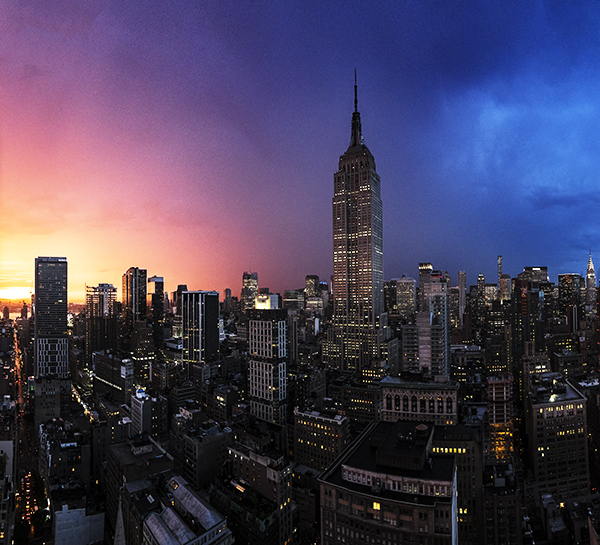
A beautiful light enveloped the city last night around sunset as storm clouds passed over us and the setting sun broke through for a brief moment. The scene was dark enough to capture the city lights as they were just beginning to come on.

This image is a composite of three vertical shots taken hand held with the Fuji X-T1 and 10-24mm zoom at its widest focal length. I have been experimenting with PTGui panoramic software for stitching multiple images together to make one large panoramic file and used it for this image instead of Photoshop. Stitching an image from multiple shots results in a much larger file capable of greater print sizes. The final file of this image came out to 132MB, which is bigger than even my Nikon 810 can produce.

One problem of panoramas is how to combine the images onto a flat surface so that they approximate true viewing perspective.  Presenting a map of the spherical earth on a flat surface is a problem that has vexed map makers for centuries. Panorama software will  usually give you a choice of the type projection you want to employ for combining your images. Below are two such projections. The top on is a cylindrical projection, as if the images were put together on a cylindrical surface. Note the telltale rounding of the foreground buildings.  The bottom image is made up of the same three photos, but it a rectilinear projection. This is closer to the natural scene -- except for the extreme sides --  as the eye sees it.


This panorama looking south in New York towards the new World Trade Center in the distance was taken the next night and represents a rectilinear projection of two combined images. 

Tuesday, May 26, 2015

Memorial Day remembrances with a Fuji X camera

On Memorial Day I attended a WWII airshow at the American Airpower Museum in Farmingdale, Long Island. In addition to the museum's permanent assortment of vintage aircraft, several guest bombers were there for the celebration. In addition to the planes there were a number of vintage land vehicles and reenactors to lend the event an air of authenticity.What better way to photograph the event than with a retro camera like the Fuji X series. So I packed up an X-T1 and X100T and off I went.

For color, I used the Classic Chrome mode with its early Kodachrome look. To further mute the color palette I dialed down the Color saturation -2 in the camera . With black and white, I boosted the contrast by augmenting the shadows and highlights and added some extra noise to the simulate grain. I still felt like I needed more in some of the images so I added a few tricks later in Photoshop. In keeping with the reenactment theme of the event I tried to create the feeling of going through some old photos discovered years later in an attic.

Not only was this a fun shoot, it was a fun post-processing time prepping the final images.

B-29 Stratofortress bomber 

B-24 Liberator bomber --  The Fuji Black & White setting with Red filter helped to darken the blue sky.

Cockpit of a B-24 Liberator bomber


Curtiss P-40 Warhawk

B-25 Mitchell bomber

B-17G Flying Fortress

M-4 Sherman tank

Douglas C-47 Skytrain preparing for takeoff

Tail of a B-25 Mitchell bomber

FG-1D Corsair with B-17G on final approach to land behind it