Tuesday, November 10, 2015

Autumnal Tints - photographed with the Fuji X-T1 and X100T

Thoreau's essay about the colors of autumn was published around the time of his death in 1862. In "Autumnal Tints" Thoreau saw the fading leaves of autumn, not as a sybols of death and decay, but as part of the beautiful process in regenerating new life.

As a photographer, I have spent many years photographing the peak colors of autumn. After reading Thoreau's essay, I took a new look at the leaves and began to realized that even after they have lost their brighter colors and begun their process of decay they display a sculptural beauty. I began photographing these late leaves of autumn in the 1980's with my Hasselblad, collecting the leaves and bringing them into the studio to be treated like any elegant prop and given a special treatment of lighting to bring out their best qualities. I have continued this project every year since.


The photos below are the results from this year's session of photographing for Autumnal Tints. They were taken on both the Fuji X-T1 with a Zeiss Touit 50mm macro lens, and the X100T set to macro mode with its 23mm f/2 lens. The optical qualities of each of these lenses are different. The Zeiss Touit is a superbly sharp modern lens producing crisp detail even when used wide open at f/2.8, as it was here. The Fujis 23mm f/2 lens is a gem in its own way. I like to use it wide open at f/2 where it has a softening quality similar to using older, uncoated optics on a digital camera.

The color images were processed as 16-bit RAW files into Classic Chrome and muted further by reducing the vibrance. Then, in Photoshop, I changed the color from Adobe RGB to LAB and punched up the muted tones. The colors are still very mute, but have a greater depth to the color range. Once finished the image is then converted back to RGB.

This photo was taken with the Fuji 23mm f/2 on the X100T, while the one below was shot with the X-T1 and Zeiss Touit 50mm f/2.8 macro. Both were used with a wide open aperture.  The Touit is super sharp, then drifts quickly to a definite out-of-focus area, whereas the Fuji 23mm is somewhat sharp where focused and progresses slowly into out-of-focus with a pleasing atmospheric haze reminiscent of 19th century optics. 


Here is the quote from Thoreau's "Autumnal Tints" that inspired me to begin this project so many years ago. I reread it every year before I begin to photograph.  The essay, "Autumnal Tints",  is perhaps the best piece ever written on the subject of the changing leaves and what we might learn from it.

"It is pleasant to walk over the beds of these fresh, crisp, and rustling leaves. How beautifully they go to their graves! how gently lay themselves down and turn to mould!--painted of a thousand hues, and fit to make the beds of us living. So they troop to their last resting place, light and frisky. They put on no weeds, but merrily they go scampering over the earth, selecting the spot, choosing a lot, ordering no iron fence, whispering all through the woods about it,--some choosing the spot where the bodies of men are mouldering beneath, and meeting them half-way. How many flutterings before they rest quietly in their graves! They that soared so loftily, how contentedly they return to dust again, and are laid low, resigned to lie and decay at the foot of the tree, and afford nourishment to new generations of their kind, as well as to flutter on high! They teach us how to die. One wonders if the time will ever come when men, with their boasted faith in immortality, will lie down as gracefully and as ripe,--with such an Indian-summer serenity will shed their bodies, as they do their hair and nails."


Friday, November 6, 2015

Fuji's 90mm lens at f/2 for beauty photography

Every now and then, on rare occasions, I happen upon a lens that produces exceptional results. I once had a 150mm Sonnar C lens for my old Hasselblad 500 cameras. It produced a creamy smoothness while maintaining great sharpness and contrast. I used it whenever I was shooting beauty assignments on film. Recently, I have been noticing another lens that is delivering exceptional qualities in a variety of situations, but is particularly good when use for beauty photography. It is the Fuji XF 90mm f/2 R LM WR lens and at $999 for the quality you get, it's a steal.

Fuji also makes the 56mm f/1.2 lens, which is sensational for portraits, very sharp with good bokeh effects . The 56mm is pretty much the perfect portrait focal length falling right in the middle of the full frame equivalent portrait range of 75-105mm. The lens was so sharp with great color, contrast and a dynamic range so extensive that when I would pick up my film from the lab I was often asked what I had used to get such a great image.

Fuji's 90mm is a little long  (equivalent to a 135mm lens) to be considered a true portrait lens, falling as it does at the beginning of the telephoto range. But I soon discovered that it focused even closer than the Fuji 56mm ( 1.97' with a magnification of .2x for the 90mm vs. 2.30' and .09x magnification for the 56mm). Most amazing of all is that the 90mm is tack sharp even at its maximum aperture of f/2. I began using it for portraits, beauty, and close-ups wide open to achieve really beautiful bokeh effects. What surprised me the most is that I could use it at f/2 on a beauty shot and still have enough depth-of-field on the face.

Below is a series of photos I did of a model, Samantha, in our studio this past week. They were all taken at wide open at an aperture of f/2 giving me plenty of selective focus in both the foreground and background.


This is the setup used to take the two photos above it -- nothing more than one 650W tungsten lamp behind the model, a black background and an assistant blowing in some canned smoke. There is no front fill. The contrast quality of the Fuji 90mm lens can handle a situation like this. 


Monday, November 2, 2015

At the end of Daylight Savings Time is a good time to photograph a city

We had a beautiful sunset in the city last night. Just after the sun went down the rays colored the overhead clouds and I took the first photo below. After that I waited for the city lights to come on in the buildings. It is a ideal time to photograph a city sunset right after daylight savings time changes back. With the sunset earlier at 4:50PM office lights in all the buildings are lit and because it isn't too late in the year most of the trees still have their leaves.

Taken right after the sun went down with a Leica M 240 and 21mm f/2.8 Elmarit-M lens. 


This photo was taken about a half hour later than the one above. There is still some color in the sky and the building lights are brightly lit because it is only 5:30PM. This image is a composite of three vertical photos taken with a 35mm f/1.4 Summilux lens on the Leica M 240. A 6 second exposure blurred the lights of traffic going around the Flatiron Building the center of the frame. 

Sunday, November 1, 2015

Autumn in Central Park with a Fuji X100T and Nikon D810

As I wrote the title of this post, I realized that putting a Fuji X100T in a kit with a Nikon D810 seems a little out of the ordinary. Here's how it happened.

I planned an autumn photo session in Central Park to gather some images for my art portfolio. This means big prints, and big prints means something like a D810, or my Leica M 240. In this case the D810 won out because I knew the zooms, particularly the excellent 70-200mm f/4 would come in handy. I had tossed a macro lens in the kit for close-ups, but last minute I decided to substitute my Fuji X100T for its unique close-up properties.  I tossed a Fuji TLC in my coat pocket to give myself an extra closer range.

One of the first photos I took was this panorama of trees around the Pond.  The final image is comprised of two images from the D810 and 70-200mm lens stitched together with PTGui. 
Although the X100T was a last minute consideration just to have some close-up ability, I ended up using as much as the Nikon for regular scenics, especially with the increased focal length thanks to the TLC.  One thing I like about shooting the X100T is that its fixed focal length forces me to compose the subject to fit the lens and not the other way around, and I often end up with a more creative solution.

This photo and the one below were both taken with the Fuji X100T. 


In this shot I particularly liked the way the Fuji X100T lens flared out the sun rays on the sides. After discovering this, I applied the technique to several other scenes throughout the day. 
That said, it was still nice to have the flexibility of the zoom lens on the D810 particularly in the telephoto range. In the situations below I relied upon the 70-200mm f/4 zoom on the Nikon D810. I kept the camera on a tripod the whole time. I find that high resolution sensors like that of the D810 tend to cause more blurring when handheld.  


One thing about a zoom is that it allows you to adapt to spontaneous events as when a rising fish caused these ripples on the Pond. 
My main reason for packing the X100T was for close-ups, but I ended up taking only a few. Instead I gathered up some leaves and carried them back with me to do some still life shots later. 

In general the autumn colors in the park this year were not very inspiring with only a few pockets of brilliant color on a lone tree here and there. 


Once again the nice lens flare from the sun was enhanced by the TLC on the X100T. 

Monday, October 26, 2015

Fuji's 90mm f/2 lens for controlling focus in lifestyle photography

Once upon a time in the old days of film the 135mm (full frame) focal length lens was a mainstay telephoto lens of every photographer. It was a little on the short side for a long reach for sports and wildlife, but came in handy for adding a telephoto effect to closer subjects. This was especially true if the lens had a fast aperture, but few of them did.

I like using a fast aperture 135mm lens for lifestyle photography for achieving a pin point focus on the subject that is separated from a heavily out-of-focus background or foreground. This is especially important where I want to leave a substantial neutral area in which art directors can work when they use my images for their ads.

In a recent shoot with a hand model, I used the Fuji 90mm almost exclusively because of its ability to focus in really tight and deliver very soft abstract patterns in the out of focus background. 
One of my favorite lenses was -- and still is -- the Nikon 135mm f/2 DC, where the "DC" stands for defocus control. This control could be used to adjust the amount of out-of-focus in front or in back of the focused point. It did work, but was quite a mild change. I never found it to be too useful. I did, however, really love the lens. It was very sharp and gave a pleasing bokeh. But this lens was made in 1990, and, although still in the Nikon lineup, is definitely due for an update to improve its performance with today's high res digital sensors.

I had pretty much given up on using this focal length until Fuji introduced its 90mm f/2 lens. This lens quickly became a game-changer, and, once again, I found myself back in love with the 135mm focal length. To make matters even better, the Fuji lens performs beautifully even wide open at f/2, which is where I use it most of the time.

The lens is exceptionally sharp wide open at f/2, which enables me to let the front and back of a scene to completely blur out.
One other feature of the Fuji 90mm lens that really expanded its usefulness, was its ability to focus in very close. It gets in to 1.97' (60cm) for a magnification of .2x. That's good enough to come in quite tight on a subject.

When I pull back a little and keep the aperture set to f/2 I can use an out-of-focus foreground to give a sense a depth to the scene. 


Integrating out-of-focus props such as this iv placed in front of the doctor, allows me to tell the story without much interference from the object.


I even like using the Fuji 90mm for some still life photography because of the pleasing bokeh effects. 


All of the samples above were taken at an aperture of f/2 to juxtapose the sharp subjects with a softer, story-telling scene. I am not a wedding photographer, but I would think this lens would be a perfect accompaniment to a wedding photographer's lens kit. It is quickly becoming one of my favorites for shooting lifestyle.

On a recent shoot outdoors, where I generally use a 70-200mm lens on a Nikon, I picked up the Fuji X-T1 with the 90mm on it just to see how it would perform in a severely backlit situation with the sun. The difference between the 90mm and the Nikon 70-200 was startling-- way more than I would even expect.

The Fuji 90mm f/2 lens is definitely one of the best optical performers in a Fuji lineup that includes some very heavy competition for that title.

Friday, October 23, 2015

Highlights of PhotoPlus Expo 2015

Yesterday was the opening day of PhotoPlus Expo 2015 in New York. There were very few bombshell announcements, Among the biggest was the new, full-frame Leica SL (Typ 601) camera. The SL has a 24MP sensor coupled to the latest version of the Maestro II processor. It can shoot at 11fps, has 4k video at both 4096 x 2160 (24p) and 3840 x 2160 (30p),  It has an incredible 4.4k EVF viewfinder.

Dials and buttons are the utmost simplicity with a readout screen on top of the body. I wasn't prepared to like this camera as much as I did, particularly the econometrics, but at a body price of $7450 I don't think I'll be rushing out to add this one to my arsenal of equipment any time soon.

The SL is shown here with its custom Leica-M adapter and Leica M lens. This is the way I would want to use this camera.  Best thing about this adapter is that it passes the lens data to the camera where the camera can make necessary corrections for the lens in order to produce optimum results. In a sense, this feature makes the camera a meaningful pro-alternative to using the Leica M itself. 

The design is minimal. If you are familiar with the Leica M menu system, the SL menu system will be a natural for you. It is quick and easy to navigate. My favorite feature on the camera is the small, ball toggle for moving the focus points. It is the quickest, easiest, most responsive focus system I have seen to date. 
While there are only going to be very few dedicated lenses initially available for the SL, it also accepts all other important Leica lenses -- Leica M, S, R via a dedicated adapter. The kit lens -- if  you can call a $4950 lens a "kit" lens -- shown here is a very practical focal length Leica 24-90mm f/2.8-4 Vario-Elmarit

Fuji didn't have too much new to announce at the show. They did show their new 35mm f/2 lens and the 1.4x teleconverter.


The 35mm f/2 Fuji lens.  At $399 it is a smaller, weather-resistant, less expensive alternative to the current Fuji 35mm f/1.4. Reports coming in make mention of its quick and quiet auto focus and high image sharpness. It weighs just a tad less than the f/1.4 model, and does not focus quite as close (13.78" or 35cm for the f/2; 11.02 or 28cm for the f/1.4), but the magnification is not that far off.  

Fuji's XF1.4X TC WR teleconverter has a limited use, currently working only on the 55-140mm f/2.8 zoom. It is also intended for the 100-400mm telephoto zoom and 120mm macro coming out in 2016. 

Among the other do-dads I saw and liked were straps and a messenger bag with a really unique fastening system -- all perfect for a Fuji-X or Leica camera system.

Cecilia straps come in a variety of width from just the strap itself up to a 1.5" neck band. They are made of leather and also come with Peruvian woven designs. The leather was very supple, a perfect accompaniment to a Fuji X camera. 
Celicia also makes leather wrist straps of the same leather. 

One of the most inovative camera bag fastening designs I have come across lately is made by Peak Design as part of a Kickstarter project.

The Peak Design Everyday Messenger bag features a unique, brushed metal clasp. Pull the square loop down to unfasten the top. Simply touch the loop to any of the four fasteners and the top flap locks with a distinct snap. The bag is rather large for a small camera system. I only wish they made one or two smaller versions. 

The GigaPan Epic Pro is something I have been considering for some time to use in my panorama work. It is a very precise machine for taking multiple pictures to stitch into ultra-high resolution panoramic images. Considering what it does, the $995 price tag, it is a reasonable enough. What has kept me from jumping in is the size. It is a large, extra piece of equipment to lug around. It does have a dedicated accessory back pack, but when I add in the camera, tripod, and lenses, the total package is getting quite cumbersome to transport.

The GigaPan comes in three sizes, the largest, and the one with the most features is the Epic Pro. It can support most any full-frame or smaller camera. This was the first time I actually saw one of these devices. I found it to be smaller than I had pictured it to be. I came very close to placing an order for one right at the show. 
The GigaPan works fully electronically. The photographer marks the starting and ending points of the image sequence, enters the lens focal length data and percentage of required over-lap, and the Epic Pro does the rest. You can use any stitching software, such as PTGui to assemble the images later.  Hardly seems fair to even take credit for taking the photo. 
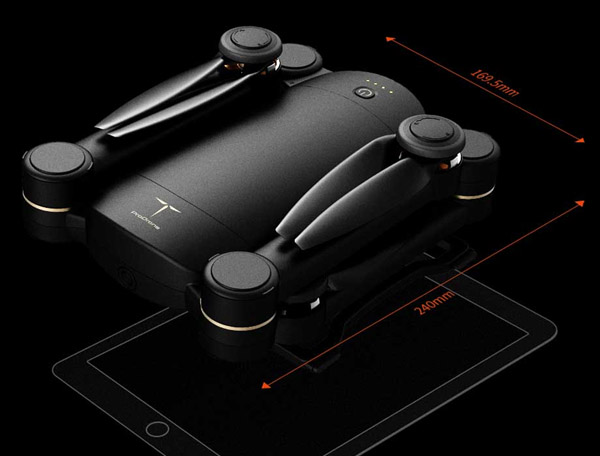
Drones were everywhere at the exhibit. I liked this new one from ProDrone. One of the nicest things about it is that it folds up into a very compact package for portability, and opens up in an instant ready to fly.

The ProDrone can be ordered with a 2k or 4k camera, or mount your own. It has a very long battery life (30 minute flight time). The drone has a very compact, easy to use flight controller. Two controls, one with over ride, can be used for flight training. 
The ProDrone folds up into a compact 169.5 x 240cm package. 


As for lenses, I've had my eye on the new Zeiss Milvus lineup for Nikon, in particular the 50mm f/1.4 or f/2 macro so I can use them for creating panoramas. These lenses are hitting the market now so I will be testing them out soon.

I liked the smaller size of the Milvus 50mm f/2 macro. It is a manual focus lens only, but that does now present any problem in using it for macros, or for panoramas where I always turn AF to off anyway. I was told by someone at the show that it is Nikon and Canon who do not allow Zeiss to make AF lens models for their cameras.