Sunday, March 22, 2015

First look -- Canon's new 11-24mm f/4 super-wide angle lens

Yes, I realize this site concentrates primarily on Nikon, Fuji, Sony, and Leica brand cameras and accessories. Once in awhile, however, something worth shouting about comes along from another manufacturer. In this case, it is the new Canon 11-24mm f/4 lens. I was able to play with one on a new Canon 5D the other day, and have to say I was extremely impressed by it.

Until now, the widest rectilinear lens available for a full frame DSLR was the variable aperture Sigma 12-24 f/4.5-5.6. Nikon has the excellent 14-24mm f/2.8, but that suffers from enough rectilinear distortion to knock its practical focal length to something closer to 15+mm once it is corrected. The Canon 11-24 did not appear to have any rectilinear distortion that I could see.


Yes, it is f/4 vs f/2.8 for the Nikon lens, but making an element for an 11mm focal length accommodate an f/2.8 aperture would have boosted the already heavy 2.6lb lens even more. I actually sold off my Nikon 14-24mm because of its weight and size.

This is the perfect lens for dramatic landscape and architectural photographs. A lens this wide is quite specialized and is not for everyone, but, if it suits your shooting style, you're going to be as excited by it as I am. Added to the newly announced 50mp Canon camera coming out later this year, this will make a perfect landscape kit.

At $2999 this lens is definitely only for photographs with a serious need for such a wide angle. When this lens is more readily available I may be tempted to run it through its paces for a hands-on blog review.

If you are planning on buying this lens, you can help support this site at no extra cost to you by clicking the link and purchasing from one of our affiliate sellers listed below -- and thanks for your support.


The Canon 11-24mm f/4 lens can be ordered from:  BH-Photo   Adorama    Amazon

Saturday, March 21, 2015

Winter's last day

Just to remind us of the fickle power of Nature, this last day of winter hit the city with a mix of snow and cold rain at a time when we have already had enough of both. It was a strange weather pattern starting late in the day so that there wasn't much built up of snow until the evening. Like most New Yorkers, I had already had enough of winter so  instead of going out to photograph anything specific I thought I would just take whatever came my way, and concentrated mostly on serendipitous abstractions.

This image and the one below is of the rain patterns through the roof of a taxi. These images are too small to show it, but the city buildings are clearly focused inside the rain drops themselves. Taken with the Fuji X-T1 and a setting of 18mm on the 18-135mm zoom.


Same situation as the photo above it, but here I switched to the Fuji 14mm wide angle lens. 


I was setting up to photograph the hanging icicles with only a little bit of the Empire State Building showing through the mist, when the clouds opened up just for a few seconds to reveal more of the identifying outline of the top of the building. I had time to grab two exposures of it before it disappeared back into the mist. 


I grabbed this impressionist view of Bryant Park later in the evening with the Sony RX100 III.  I liked the way the blur pattern emphasized the driving snowy mix and made the scene more abstract. The ISO was set to 1600, and instead of eliminating all the noise, I corrected only part of it leaving some to preserve the impressionist effect it lent to the picture. 


Friday, March 20, 2015

My Fuji X-T1 goes to the cleaners

Yesterday I posted an image I took with my Fuji X-T1 and an aperture setting of f/22. Normally, I would not use an aperture that stopped down, but events were happening rapidly and I did a quick setting so as not to miss the rapidly changing scene. Good thing I did because after only one exposure it was all over.

I mentioned in the post that using f/22 at least showed me how dirty my sensor had become. I did a cleaning of it myself, but decided it was time to treat the camera to a professional sensor cleaning. Generally, depending upon use, I have my cameras professionally cleaned once or twice a year. This is in addition to the normal cleanings I give the sensors whenever they seem to need it. My X-T1 was obviously long overdue for a serious visit to the cleaning professionals over at Foto Care.

I used to send my cameras back to the manufacturers for a major cleaning, despite the fact that I lost a lot of time that way because of having to mail them in and wait for service. Now I take them for a professional cleaning at Foto Care in New York City, where I get same day service and the camera gets as good, if not better, service as it did from the manufacturers.

In a clean room the camera is first treated to an exterior brushing to eliminate any exterior dust particles that might cause trouble during the sensor cleaning stage. 

Next the sensor is tested with the lens aperture set to f/8. A translucent filter is placed over the lens and a photo is taken of a pure white light.

The image is then analyzed at high contrast for dust, grime, or streaks. This is the first of several images that will be taken until the sensor it thoroughly clean.

Here the sensor is examined under a loupe to see exactly where the problem areas are.

The sensor is treated to a series of cleaning steps depending upon how dirty it is. My X-T1 was very dirty so it received the full treatment -- several times. 

One of the steps may include a swab cleaning. If you have never done this, you may want to leave it to the professionals. You can cause more trouble, not to mention damage, with a damp swab cleaning if you don't do it correctly. Oscar, who cleaned my X-T1, looked like he had performed this procedure a zillion times. Even so, he proceeded with the utmost caution. 

My X-T1 needed several swab cleanings. After each one the camera was re-examined with a sensor test and loupe examination until it was spot free. Foto Care charges $50 for this service -- well worth it, if you ask me. If you are in New York and want to treat your camera to a professional sensor cleaning, visit the fine folks at Foto Care. They clean every type of camera - DSLR, mirrorless, and cine. Foto Care is a shop visited by most New York professional photographers. It is located in the Photo District of New York at 43 West 22nd Street. When there, ask for Jeff, the owner. Tell him I sent you. You won't be disappointed.

Oscar hands me back my X-T1 with its sparkling sensor. Thanks Oscar!


Thursday, March 19, 2015

Breezy day in the Big Apple

The wind was really blowing in the city today and the clouds overhead were moving rapidly from west to east. I used the opportunity to grab a 30 second time exposure of some clouds moving behind the Empire State Building. The day was bright so I used two ND filters totaling 10-stops. With the lowest ISO setting, the aperture was set to give a 30 second exposure at f/22. I had an opportunity for only one nice pass of the clouds before they dissipated.

One thing I learned from shooting the sky at f/22 was how filthy my X-T1 sensor is -- definitely in need of a professional cleaning.

Photographed with the Fuji X-T1 and 18-135mm zoom set to 22mm and f/22 with an exposure of 30 seconds at ISO 100. 

Tuesday, March 17, 2015

Choosing between the Fuji 16-55mm f/2.8, 18-135mm f/3.5-5.6, and 18-55mm f/2.8-4

Decisions, decisions.

In my latest hands-on review of the Fuji 16-55mm f/2.8 I mentioned that with this lens Fuji expands its lens system with a redundancy that covers more that one solution to the same optical coverage. For the consumer, this means more choice within the various focal length categories allowing photographers to tailor their lens choices to the specific way they use their equipment. A serious landscape photographer has very different equipment needs than a still life or lifestyle photographer, just as a photographer using the equipment casually has a different criteria than a pro who relies on it to make a living.

I have received a number of emails from readers asking which of the three lenses I would recommend based upon specific criteria. So I decided to dedicate a blog post to the topic, and here it is.

Here is one of the questions I received recently:

"I was thinking of buying the Fuji 18-135 as a convenient lens to used round the salt mashes, mudflats and coastal areas where I live. However the 16-55 seems to be having rave reviews, including your just published  review.

My question is:- would the 18-135 stopped down to f8-11-16 produce similar results to the 16-55 or is this in a different league altogether (I appreciate the different focal lengths) especially as I need to get up to A2 sized prints." 

First of all, let me say: Fuji makes great lenses. All of these zooms will produce excellent results. Even the small 18-55mm, considered something of a kit lens, can hold its own with no apologies necessary. Is the 16-55mm f/2.8 best of breed?  Well, yes. In fact it comes as close as you can get to shooting a prime for quality. 

All of these lenses can deliver the goods optically, although, yes, something like the 16-55mm f/2.8 takes it up a notch. What I am considering here is whether or not this extra up-tick in resolution is always necessary, and do some of the physical features of one of the other zooms make them a more practical choice for the task at hand.  So the more important question we need to ask ourselves is what do we want to do with the lens. 

The question our reader posed was one of quality in an A2 (approximately 16 x 20") print size. Considering the distance at which a print this size will be viewed, I think that any differences between the lenses is going to be negligible for most landscape work. More importantly is the techniques employed in taking the photograph. On a tripod, stopped down, with a RAW file to capture the most extended range will deliver excellent results with from any of the three. But A2 is about the largest we can go comfortably with an APS outfit. Larger than that, and we want to introduce any and all efforts to obtain the best quality original file, and means relying on the best optics that come from a lens like the 16-55mm. 

Of the three zooms, only one, the 18-135mm, can be considered a do-everything lens. (You can read my full review of it here.)   It is not a small lens, but it has the advantage of covering a range broad enough not to necessitate carrying any other lenses along with it. This practicality keeps it glued to my camera most of the time. If I had to pick one, and only one lens, for my Fuji camera, this is the one I would choose. 

Having the extra two millimeters of 16mm vs 18mm on the 16-55mm f/2.8 results in a more practical 24mm equivalent wide angle focal length than 27mm. Going down to 16mm can often save you from having to carry another wide angle lens. 


The 18-135mm has the smallest maximum aperture of the three. At f/3.5-5.6 we aren't going to be talking too much about bokeh in our description. The other downside of a slow aperture lens is having to use it at slow shutter speeds or high ISO setting. In this case, however, the small aperture is offset by an unprecedented 5-stop OIS. The hype is probably more than the practical reality, but I use this lens a lot and the results are quite impressive. Stated simply: The high OIS more than compensates for the slow aperture. 

The variable aperture on the 18-55mm isn't really so bad -- not very effective for nice bokeh, but adequate for hand-held photography with an OIS lens. This lens has the added benefit of being quite compact. 

I use the 18-135mm lens more than any other for walking around photography. It covers such a broad range of focal lengths that I rarely need any other lens -- except occasionally a super-wide -- to supplement it. The 5-stop OIS works so well that I use the lens hand-held even at night. When my camera is just sitting around on the ready for a spontaneous moment, this is the lens I keep on it. 


Consider the Kit:

Rarely do we use these lenses in isolation when out for some serious shooting.  So another question we need to ask ourselves is what other lenses we would pair with one of these zooms to make up a complete kit. It is one thing to have a very compact zoom like the 18-55mm, but, if it means having to tuck another long zoom into the bag to make up for the lack of longer focal lengths, it might negate the size advantage. 

The 18-135mm is the only one of the three that can be considered a stand-alone kit, although even it would benefit from having a super-wide, like the Fuji 14mm, Zeiss Touit 12mm, or Fuji 10-24mm to cover the lower end.  The 18-135mm also focuses close enough to consider even dropping a macro lens from our kit. 

Taken with the 18-135mm zoom at full extension and closest focus point. Being able to achieve a close up like this may spare us from having to add a macro to our lens kit. 
The 16-55mm f/2.8 is meant to be accompanied by the 50-140mm f/2.8 zoom, and anyone using this lenses would probably want to put the two together. This is a heavy kit, but no one is picking up these lenses to keep their kit light. They are acquiring them because of their pro-level durability, optical quality, and features, as well as for the fixed, fast maximum aperture. Adding any of the available super-wides to accompany these two zooms, and you have a complete kit, second to none, although you may want to toss in a macro, too. Large and heavy as this complete kit is,it is still considerably smaller than an equivalent full frame DSLR outfit of the same ingredients. If the Fuji X camera were the only one I used for all the work I do, I would have this entire outfit. 

The 18-55mm f/2.8-4 that accompanied the Fuji X cameras from the beginning is still a viable choice for a light-weight, single lens only option. For more serious shooting, it's going to need something like the 55-200mm to keep it company, and because neither of them get close enough, we might need to toss in a macro also. Before the other two zoom came out, I used to use a kit like this for travel, but I also found I had to include at least one fast prime, like the 23mm f/1.4 prime, for dark situations I often encountered when doing travel photography. Once the kit begins to include all this extra stuff, it makes the heavier 18-135mm zoom look like a more convenient option. 

I could go on forever with this discussion because there are as many different photographic situations as there are photographers, each with its own requirements for a lens kit. Each of us is going to have to decide what to get based on our own needs and work habits. Thankfully, Fuji has provided us with enough options to tailor a lens kit to suit. The bottom line here is that no matter which kit we finally assemble, it is going to be the right one in terms of providing quality results. 

Both the 18-135mm and 18-55mm have recently had their prices reduced making them and even more attractive purchase. All three lenses are available from the affiliates listed below, where our blog receives a slight percentage of the sale -- at no extra cost to you -- and  helps keep the site running. 

The Fuji 16-55mm f/2.8 lens can be ordered from:  BH-Photo  Adorama  Amazon

The Fuji 18-135mm f/3.5-5.6 lens can be ordered from:  BH-Photo Adorama Amazon

The Fuji 18-55mm f/2.8-4 lens can be ordered from:  BH-Photo Adorama  Amazon    

Saturday, March 14, 2015

Using the Yongnuo remote flash trigger with the Fuji X-T1 -- Part II


Some time ago I wrote a post about using a remote flash trigger that can be used on a Fuji X-camera to set off a remote flash, like the Nikon SB series.  Since then there I have received a number of emails, comments, and questions on the topic that I thought I'd do a Part II addendum to the former post with step-by-step illustrations of how to go about setting them up.

Any flash used with a Fuji X-camera, other than a dedicated Fuji flash, can only be used in manual or automatic mode. 

As a side benefit, the two Yongnuo units can be set up as a wireless remote control of the camera. Simply attach a cord from the side of the unit to the cable release input on the Fuji X-camera. 

These are the two remote units that come with the package. The Yongnuo model number is: RF-603NII, where "N" in the number stands for Nikon model. There is also a Canon model that I think should also work, but I don't have Canon gear to test one, and have read some reports of problems with the Canon version and an X-T1.

These units are transceivers, meaning they can both transmit and receive depending upon how they are set. A pair of them costs a little over $30. You need one for the camera to transmit, and one for the flash to receive. The package also comes with a cable to convert the two units into a wireless remote control trigger for the Fuji X-camera.

Mount the RF-603 on the X-T1 hot shoe and turn it on to TX, for transmit.

Mount the second unit on the flash and turn it on to TRX, for receive. You can test the connection from either unit by pressing the test button on top.of it. 

When shooting with a flash on a Fuji X-camera, the frame rate needs to be set to "S" for Single, otherwise the camera will not shoot. 

Here the Nikon flash is set to ON and Manual mode. Note that the flash focal length is set to FX zoom. To be totally accurate this should be changed to DX when used with the Fuji X APS sensor.

In this instance, the Nikon flash is turned ON and set to Auto mode.The flash automatically adjusts it output to achieve the correct exposure.  I find that this works quite well and the exposure can be further adjusted on the Fuji camera by using the exposure compensation dial.  

Here the Nikon flash is set up as a Master unit so that it can control another flash, either another Nikon flash or a second Yongnuo flash. In this case, both units are on Channel 1. We could set up more units on the same or different channels.

Below is a short video I did to demo the setup on a Fuji X-T1, X100T, and X-Pro1.


Any of these units will work with a Fuji X-camera, but only designated units can also be controlled by a Nikon or Canon camera so be careful about which model you are ordering. It gets confusing and the prices vary slightly, but here is a list with a link to their availability on Amazon. You can also find them on eBay, but by ordering on Amazon  you get the instant gratification of receiving them right away. 

For pro Nikon cameras and the X-T1:
Yongnuo RF-603NII-N1 Wireless Flash Trigger Kit for Nikon D700, D750, D800, D810, D1 D2 D3 D4, D4s

For amateur Nikon cameras and D610 series, and the X-T1:
Yongnuo RF-603NII-N3 Wireless Flash Trigger Kit for Nikon Nikon D90 / D7000 / D7100 / D5000-5500/ D3100 - D3300 / D600 / D610

For pro Canon cameras and a Fuji X-camera:
Yongnuo Upgrade RF-603 II C3 2.4GHz Wireless Flash Trigger/Wireless Shutter Release Transceiver for Canon 1D/1DS, EOS 5D Mark II/5D/7D/50D/40D/30D/20D/10D Series (RF603II C3)

For Canon cameras and Fuji X-camera:

Wednesday, March 11, 2015

Fuji XF 16-55mm f/2.8 zoom -- a hands-on review

As one of the most popular focal length zoom ranges of many pro photographers, the Fuji 16-55mm has been eagerly awaited as a complement to the already released Fuji XF 50-140mm f/2.8 zoom providing an f/2.8 focal length range from an equivalent 24mm to 210mm. Throw in the Fuji 10-24mm f/4 lens and you have a all you need optically to cover almost anything there is.  And "why not a 10-24mm f/2.8" you may ask. Because it would be huge and fly in the face of what an APS mirrorless system is all about, namely light weight, compact size. 

Compactness and size is one of the reasons the 16-55mm does not have image stabilization. It would have added much to the bulk and weight, not to mention the price. There has been a lot of vocal criticism of this missing feature, but both Nikon and Canon have gotten away with a lack of IS in their equivalent zooms for years. Image stabilization, while a welcome asset, is not as necessary on shorter lenses as it is on longer lenses where the longer focal lengths magnify the motion in proportion to their length.  As I mentioned in my announcement of this lens, an old photographers rule of thumb is that it takes a shutter speed approximately equal to the focal length to be able to hand-hold a lens. With that dictum in mind, it would only take 1/25 second to safely hand hold a 24mm lens, but about 1/250 second to have the same hand-held control over a 200mm lens. Enough said on that point. This lens doesn't have OIS. If you require it, this lens is not for you.

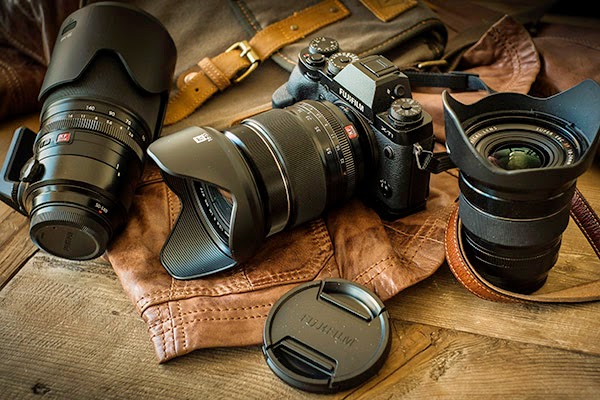
A perfect, pro-level lens kit for almost anything: The Fuji XF 50-140mm f/2.8, XF 16-55mm f/2.8 on the camera, and the XF 10-24mm f/4 super wide zoom. You could lighten the load a bit by substituting either the Fuji XF 14mm f/2.8 or Zeiss Touit 12mm f/2.8 for the larger Fuji 10-24mm zoom. I personally find that I don't really need a zoom in the ultra short zoom range because it means I am working in close and moving back or forward a little bit almost accomplishes the same thing. Plus I'd rather be using a prime in this focal length range. Toss in the 1.4x teleconverter due out towards the end of the year, and you're covered to almost 300mm. 

What this lens does have is quality, both build quality and optical quality. Take a look at the lens kit I put together in the above photo. A truly excellent and still relatively compact outfit doesn't get much better than this and still deliver a fairly fast aperture of f/2.8 -- the 10-24mm excepted. I have been photographing with a similar triumvirate of zooms for decades, but never,  until now, has the entire system been so good and so compact. OK, I realize these f/2.8 lenses are bulkier than the variable aperture Fuji zooms we've been using so far. But that is the trade off for a fixed, fast aperture lens. And still, it is still not as big and bulky a system as carting around an equivalent full frame DSLR.

As a pro-lens the XF 16-55mm has an aperture ring with marked diaphragm stops. This is unlike Fuji's other lenses where the aperture ring is free tuning and selection is made on the viewfinder. 


 Specifications:


As a member of Fuji's pro-level cameras, the 16-55mm has a weather  resistant design with 14 sealing points. It also has nine rounded aperture blades as opposed to the seven blades on the other two similar zooms, the 18-55mm and 18-135mm lenses. The extra blades mean a rounder shape to the diaphragm as it closes, which in turn results in more pleasing bokeh effects.

The 16-55mm has an introductory price tag of $1199.95, which about double the other two Fuji zooms in this focal range, but still quite reasonable for a pro quality lens in this category.

The larger X-Pro1 body is a more comfortable balance with a larger lens like the Fuji 16-55mm f/2.8. Looks really nice, too. 


Autofocus is a quick, .06 seconds and nearly silent making it easier to track fast moving subjects like this air-borne skate-boarder. 

Test shots such as this jpg taken at f/2.8 and 16mm show the lens to be very sharp extending even into the corners. It exhibits minimal distortion and vignetting at this aperture, and, of course, improves as it stops down towards the sweet spot of f/5.6 and f/8. Performance like this makes the lens a perfect choice for architectural and landscape photography. It is rare to find lenses of this consistent image quality, but Fuji seems to have mastered the knack of creating them.  Download a high res sample of  this image by clicking here.
As for optical quality and resolution, Fuji does it again, this time producing a zoom lens that is as good as a prime. The 16-55mm has 17 elements in 12 groups that include 3 aspherical elements to control spherical aberration and distortion. There are 3 ED lens element that keep lateral and chromatic aberration to a minimum.

Nano-GI coating lens elements keeps ghosting and flare to a minimum and maintains good subject detail even when pushing the limits by shooting directly into the sun in a clear, cloudless sky.


By extending to 55mm the lens gets us closer to a true portrait length and the constant f/2.8 aperture delivers a pleasing enough out-of-focus area behind the subject. 


Having 16mm (24mm equivalent) focal length at the short side of the zoom range makes this lens truly practical for landscapes and interiours in particular. Just add the 14mm Fuji or 12mm Zeiss Touit to your kit will pretty much cover most wide angle situations.  It is in the upper corners of images like this where the leaves open up to reveal the bright sky that chromatic aberration will usually occur. Here there is nothing to show because there isn't any.


The 16-55mm can focus as close as 30cm at its widest setting of 16mm, and 40cm at 55mm -- not a record breaker, but respectable. 


Conclusion:

The Fuji lens lineup has matured substantially by adding a professional 16-55mm f/2.8 mid-range zoom to its lineup. This substantially extends the choices available to photographers. There are now three zooms that cover a similar range, the 18-55mm f/2.8-f/4, and the do-everything lens, the 18-135mm f/3.5-5.6 with 5-stop image stabilization. These are all good lenses with the 16-55mm being the best of breed in terms of optical quality, as is fitting a lens aimed at professional use.

The current crop of available lenses plus the new equipment due out over the course of the coming year make the Fuji mirrorless X-system truly an alternative to a pro-level DSLR system. I have already begun incorporating the X-T1 into shooting situations like lifestyle and travel. In fact I now often travel with only the X-T1. 

This lens is not for everyone. Each of us will have to decide how it fits into our workflow. I will probably not acquire the 16-55mm f/2.8 for my own kit, but that is because I already have the 18-135mm for travel work, and because I still prefer to use a very high resolution full frame DSLR for landscape work. If I were a wedding photographer depending only upon a Fuji equipment kit, I would add this lens to the mix for its high resolution and fast aperture. Same would be true if I only used a Fuji X camera for lifestyle or landscape photography. 

Most importantly, the 16-55mm lens and its longer brother, the 50-140mm f/2.8 extend the Fuji accessory range to cover a broader range of uses and choices. This is the mark of a truly professional system, one that Fuji appears intent on pursuing. Extensive lens support is a pre-requisite of any pro camera system intending to cover the myriad subjects and needs of individual photographers. Hats off to Fuji for realizing that and doing something about it.


This is not a straight shot taken with the lens. I cheated a bit by applying some softening technique to the scene. But then again, that's what "Hands on" testing is all about -- using equipment to see if it can fit in with the way you shoot.  To create this image, I first over-exposed the scene by one stop. Then, working with the RAW image, I brought it into ACR (Adobe Camera RAW) where I output one image with a bit of added contrast, and a second version with the Clarity slider moved all the way to the left to soften it. Finally, I opened the first, sharp image in Photoshop, and then put the second, softer image on top of it as a layer with its mode changed to Soft Light. A little bit of further tweaking and I arrive at this version with a soft effect laid over a sharper image for a moody look to the sunrise. 
If you are planning on buying this lens, you can help support this site at no extra cost to you by clicking the link and purchasing from one of our affiliate sellers listed below -- and thanks for your support.

The Fujifilm XF 16-55mm f/2.8 lens be ordered from:  BH-Photo   Adorama   Amazon