 |
| I happened on an empty movie theater where I captured this shot using my cell phone camera, adding the lens flare later in Photoshop. |

A photography blog covering: Digital, Film, Reviews, History, Cameras, Images, Technique, Stock Photography, and pretty much anything else photography related that comes to mind...with special coverage of Fujifilm X, Nikon, Sony, and Leica cameras.
Thursday, November 15, 2012

Tuesday, November 13, 2012
Classic Leica Cameras Calendar
Every year I do a calendar for myself using my images. This is a selection of photos I took recently for my personal calendar for 2014. All the photos are of antique Leica cameras in period still life situations.
I put two versions of the calendar on LULU.COM. If anyone loves Leica cameras as much as I do and wants a copy or just wants to check it out, you can access it here: CLASSIC LEICA CAMERAS 2014 CALENDAR.
I still shoot film with some of these cameras today.
I put two versions of the calendar on LULU.COM. If anyone loves Leica cameras as much as I do and wants a copy or just wants to check it out, you can access it here: CLASSIC LEICA CAMERAS 2014 CALENDAR.
I still shoot film with some of these cameras today.
 |
| Leica IIIf - c1954, with complete Leica case of lenses and accessories |
 |
| Leica IIIb - c1938 with 8.5cm f/1.5 Summarex lens |
 |
| Leica IIIf - c1952 with a 20cm Telyt lens and Visoflex I viewer, shown here with a Weston Master III light meter of the same period. |
 |
| Leica I (c1930) with Ur-Leica photo by Oscar Barnak using the first Leica prototype in 1913. |
 |
| Lecia M4 (c1968) - My favorite film Leica, and the one I use today when I want to do some serious black and white film photography. |
 |
| Leica III - c1937 with the special 9cm Thambar lens and soft focus filter. |
 |
| Leica IIIc - c1944 |
 |
| Leica III - c1938, one of my favorites. It currently sits on my desk loaded with film and ready to shoot. |
 |
| Leica Standard - c1932 |
 |
| Leica M2 with dual-range Summicron c1959. This was the first Leica camera I used professionally. |
 |
| Leica IIIg - c1957 |
Monday, November 12, 2012
I always carry a camera with me when I am out in case I happen upon something interesting. Recently, I have been carrying the Sony DSC-RX100 because it fits easily in a pocket, has a zoom lens, and packs 20mp out of a 1" sensor. The results are really very good. In fact it may be the best pocket camera out there.
The focal length of the zoom lens is equivalent to 28-100mm on a full frame camera. Problem is the word, "equivalent". The real focal length of the lens is 10.4-37.1mm, and even though the maximum aperture ranges from f/1.8-f/4.9, such a short focal length just does not allow for a shallow enough depth of field that would throw a background out of focus -- even when the lens is used wide open.
I happened on the scene below of some stanchions set out on a sidewalk. I wanted to grab a shot that singled out the stanchions and left the distracting background out of focus. As you can see, even wide open the depth of field is to deep.
I was close to home so I went back for my Nikon D800 with a 105mm f/2 lens and a 70-200mm f/2.8. You can see the difference in the two bottom images.
 |
| Taken with the Sony RX100 with the lens racked out all the way to 37.1mm (equivalent to 100mm) and shot wide open at f/4.9. The distracting background is too much in focus -- exactly what you would expect with a 37mm lens. |
 |
| This photo was taken with a real 105mm lens on a Nikon D800. The lens aperture was wide open at f/2. This caused the background to be completely blown out into a nice bokeh. |
 |
| Here a 200mm focal length was used on the Nikon 70-200mm lens at f/2.8. Once again the out-of-focus background and foreground add nice bokeh that enhances rather than detracts from the scene. |
Sunday, November 11, 2012
On my early morning bike ride the sun was low in the sky and softly filtered by a light fog. The glass buildings along the Hudson River had a bright, pastel look to them that was muted by the back-lit haze. I used a Nikon D600 and 24-120mm lens to photograph these two important examples of modern architecture.
 |
| This is the AIC building by Frank Gehry. |
 |
| Here the low morning sun shines right through one of the apartment towers designed by Richard Meier. |
Friday, November 9, 2012
Whenever I photograph I include a gray card that enables me to adjust the color balance later in post-processing. It is not that I always balance the color to a normal setting. Sometimes I prefer the color cast to be more cool or warm. But at least I know what "normal" is and can deviate from there.
The card I carry with me is the QPcard 101. It is small enough to conveniently fit in a vest pocket or camera bag. The images below show a rather dramatic example of how effective these cards can be.
The card I carry with me is the QPcard 101. It is small enough to conveniently fit in a vest pocket or camera bag. The images below show a rather dramatic example of how effective these cards can be.
 |
| I took this photo with available window light very late in the day under exceptionally cloudy conditions. Under such circumstances, colors will normally tend to a heavy blue range. After correction in post processing the colors were restored to normal. |
 |
| Here is a before and after using the QPcard 101. The upper photo shows the results using an auto white balance camera setting. It tends heavily towards a blue cast. In post-processing I clicked on the white or gray area to correct the color to normal. The gray block usually results in a slightly warmer rendering. |
 |
| This is the finished photo. Once I had achieved the correct color balance, I pushed it a bit further to warm it up. |
 |
| Just to show the extent of this color correction method, this image was taken even later in the day using only moon light. The exposure was 10sec at f/8 and ISO400. Under these circumstances the true color was completely skewed. Nonetheless, I was able to easily correct it to normal in post-processing with one click of a mouse button. |
Thursday, November 8, 2012
Every year I do some still life images of late autumn leaves, leaves that are past their color prime and have more of a sculptural quality in their decaying state. This project was inspired after I had read an essay by Thoreau, entitled "Autumnal Tints". My ultimate goal it to make a book of the finished project.
I am including a few of the images I took this year as part of my late autumn project. This year I used a technique of extreme depth of field to bring out a high resolution, sculptural quality to the individual leaves. To do this I took approximately 25 photos of each leaf. I racked the focus out a tiny bit for each of the 25 images until the entire scene was covered. Later I combined all the images into one super-sharp image using the program from Heliconsoft called, Helicon Focus.
It is impossible to really see the incredible sharpness that resulted from this technique from the images in this blog. So I have included a link to a larger file size. You can access it by clicking on each image.


Here is the full quote that inspired this project. It is from the essay, "Autumnal Tints" by Henry David Thoreau, and was published in 1862:
"It is pleasant to walk over the beds of these fresh, crisp, and rustling leaves. How beautifully they go to their graves! how gently lay themselves down and turn to mould!--painted of a thousand hues, and fit to make the beds of us living. So they troop to their last resting place, light and frisky. They put on no weeds, but merrily they go scampering over the earth, selecting the spot, choosing a lot, ordering no iron fence, whispering all through the woods about it,--some choosing the spot where the bodies of men are mouldering beneath, and meeting them half-way. How many flutterings before they rest quietly in their graves! They that soared so loftily, how contentedly they return to dust again, and are laid low, resigned to lie and decay at the foot of the tree, and afford nourishment to new generations of their kind, as well as to flutter on high! They teach us how to die. One wonders if the time will ever come when men, with their boasted faith in immortality, will lie down as gracefully and as ripe,--with such an Indian-summer serenity will shed their bodies, as they do their hair and nails"
I am including a few of the images I took this year as part of my late autumn project. This year I used a technique of extreme depth of field to bring out a high resolution, sculptural quality to the individual leaves. To do this I took approximately 25 photos of each leaf. I racked the focus out a tiny bit for each of the 25 images until the entire scene was covered. Later I combined all the images into one super-sharp image using the program from Heliconsoft called, Helicon Focus.
It is impossible to really see the incredible sharpness that resulted from this technique from the images in this blog. So I have included a link to a larger file size. You can access it by clicking on each image.

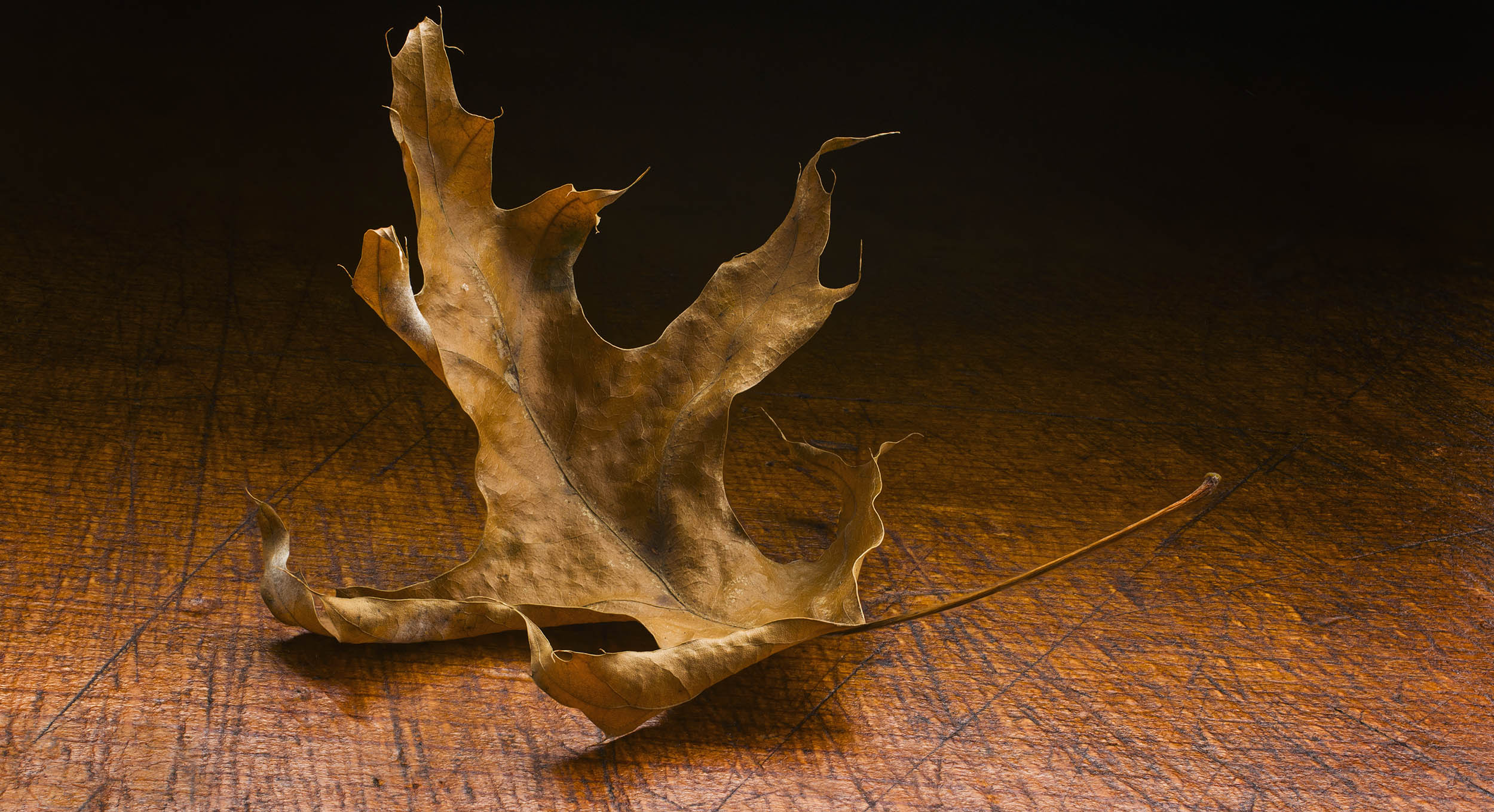
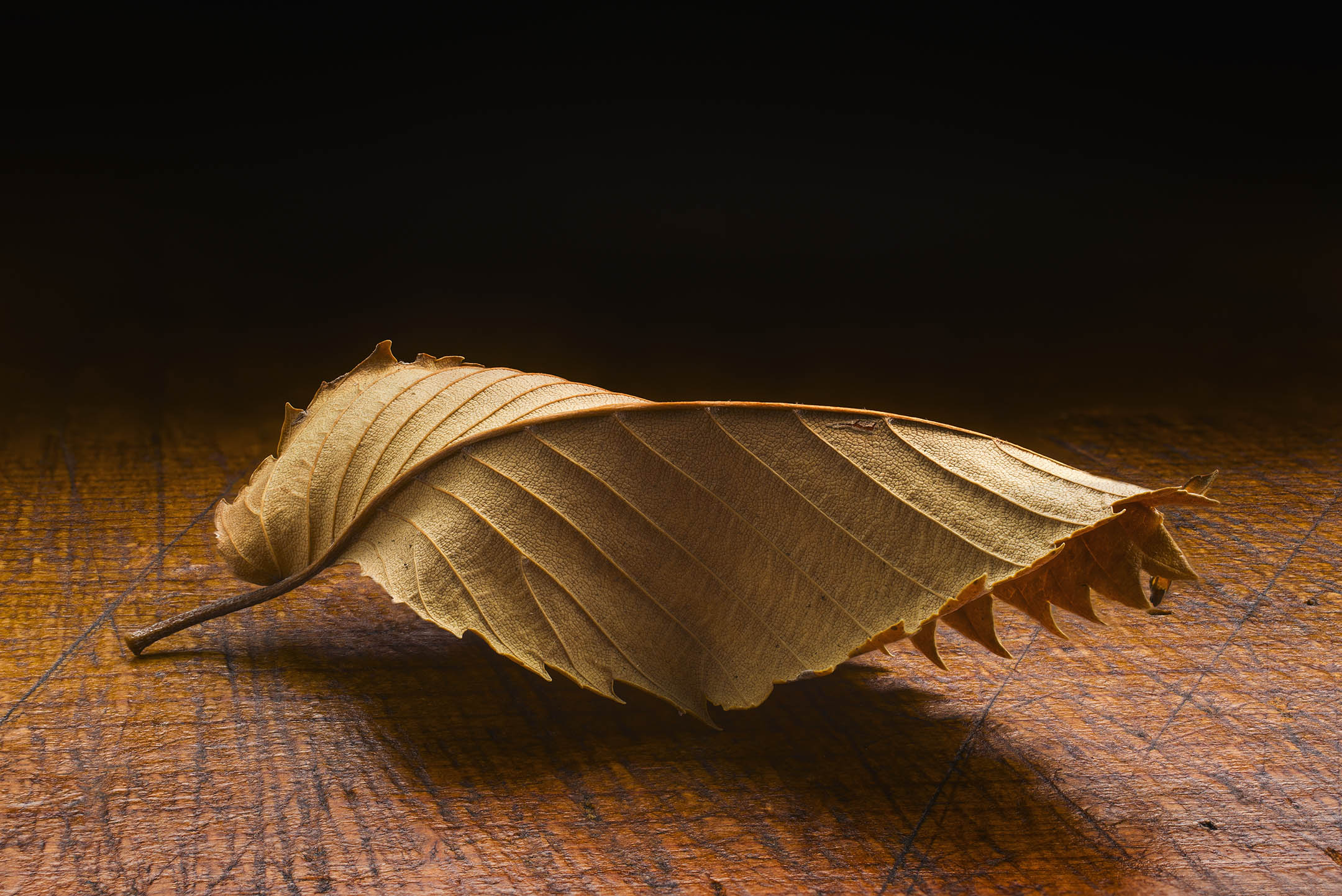
Here is the full quote that inspired this project. It is from the essay, "Autumnal Tints" by Henry David Thoreau, and was published in 1862:
"It is pleasant to walk over the beds of these fresh, crisp, and rustling leaves. How beautifully they go to their graves! how gently lay themselves down and turn to mould!--painted of a thousand hues, and fit to make the beds of us living. So they troop to their last resting place, light and frisky. They put on no weeds, but merrily they go scampering over the earth, selecting the spot, choosing a lot, ordering no iron fence, whispering all through the woods about it,--some choosing the spot where the bodies of men are mouldering beneath, and meeting them half-way. How many flutterings before they rest quietly in their graves! They that soared so loftily, how contentedly they return to dust again, and are laid low, resigned to lie and decay at the foot of the tree, and afford nourishment to new generations of their kind, as well as to flutter on high! They teach us how to die. One wonders if the time will ever come when men, with their boasted faith in immortality, will lie down as gracefully and as ripe,--with such an Indian-summer serenity will shed their bodies, as they do their hair and nails"
Wednesday, November 7, 2012
1938 Photo-journalists camera kit
Here is another photo in my series on what the well-dressed photographer would carry at certain periods in history.
The camera is a 1938 Leica III in black paint. It is equipped with a 2.8cm f/6.3 Hektor lens, which was the extreme wide angle of its day and had just been introduced in 1935. The background telephoto lens is a 13.5cm f/4.5 Hektor. In the foreground is a 5cm Summar with a fast f/2 aperture. Next to the camera on the left is a variable focal length viewfinder. The Art Deco styled Remington 5 typewriter in the background is also of the same period.
This photography kit was state of the art in its day -- completely manual, built in range finder, and shutter speeds from 1sec to 1/500 sec. It is also one of the most beautiful cameras ever made and copied in retro-style designs even today.

Here is another photo in my series on what the well-dressed photographer would carry at certain periods in history.
The camera is a 1938 Leica III in black paint. It is equipped with a 2.8cm f/6.3 Hektor lens, which was the extreme wide angle of its day and had just been introduced in 1935. The background telephoto lens is a 13.5cm f/4.5 Hektor. In the foreground is a 5cm Summar with a fast f/2 aperture. Next to the camera on the left is a variable focal length viewfinder. The Art Deco styled Remington 5 typewriter in the background is also of the same period.
This photography kit was state of the art in its day -- completely manual, built in range finder, and shutter speeds from 1sec to 1/500 sec. It is also one of the most beautiful cameras ever made and copied in retro-style designs even today.

Subscribe to:
Posts
(
Atom
)